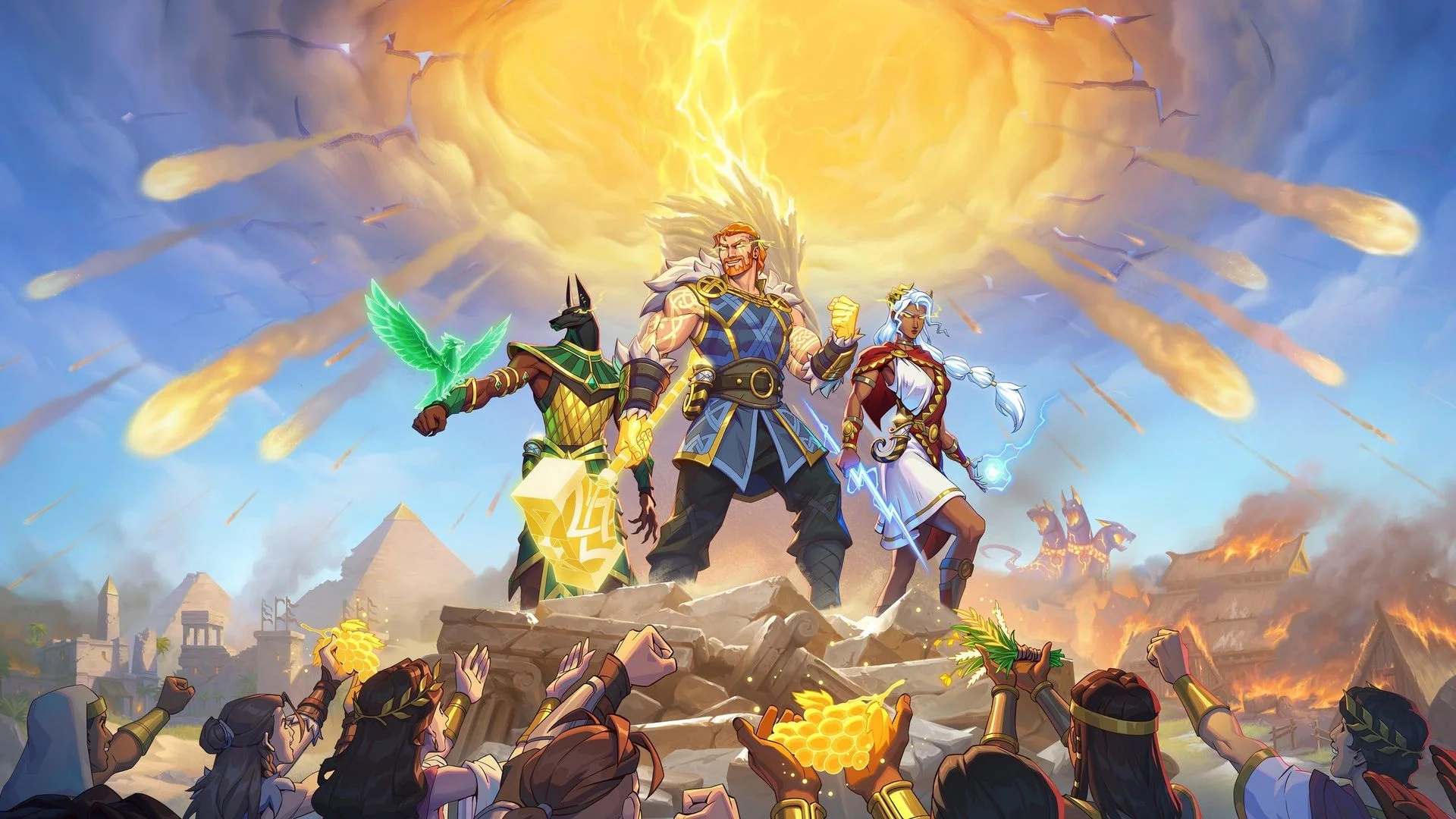
- Aftergods review verdict: a promising mythic open-world survival RPG by Norsfell, revealed October 8, 2026
- Core hook: play a Godborn balancing divine and mortal forms after Ragnarok
- Best systems: shapeshifting into Phoenix, Manticore, and Siren forms for traversal
- Co-op support: solo, online co-op, offline play with P2P and dedicated servers
- Status: release date still TBA on PC, PS5, and Xbox Series
Aftergods Review: First Impressions and Core Identity
Aftergods made its public debut on October 8, 2026, and this Aftergods review breaks down what the reveal tells us so far. Developed by Norsfell, the game is a top-down, open-world survival action RPG set in a world shattered by Ragnarok. You play as a Godborn — a survivor carrying divine blood — tasked with exploring ruined realms, recruiting followers, building temples, and collecting World Tree seeds to restore a broken world.
The premise blends Greek, Egyptian, and Norse mythology into one post-apocalyptic fantasy setting, and that mashup is the game's strongest identity marker. Rather than a traditional survival sim, Aftergods positions itself as a "survivalite" — a design philosophy that reduces repetitive grinding and harsh punishment loops common in the genre.
Here is how the confirmed fundamentals stack up:
| Category | Details |
|---|---|
| Developer | Norsfell |
| Genre | Top-down open-world survival action RPG |
| Platforms | PC, PlayStation 5, Xbox Series |
| Modes | Solo, online co-op, offline play |
| Release date | TBA (revealed October 8, 2026) |
| Languages | 12 interface languages on Steam |
Aftergods has not officially launched as of October 2026. This review evaluates announced systems, official store information, and confirmed design goals — not final gameplay balance.
Gameplay Systems Review: Godborn, Nectar, and Forms
The heart of Aftergods is the tension between your divine form and mortal form. Divine power is fueled by Nectar, a strategic resource tied to progression. Spend it carelessly and you may find yourself stranded in a hostile region with only mortal capabilities — slower, vulnerable, and forced to rely on preparation and positioning.
Our assessment of the survival loop:
| System | Role | Review Verdict |
|---|---|---|
| Nectar | Fuels divine power and progression | ★★★★☆ Encourages planning over spamming |
| Divine Form | Empowered combat state | ★★★★☆ Meaningful power fantasy with limits |
| Mortal Form | Vulnerable fallback state | ★★★☆☆ Adds tension; risk of frustration |
| World Tree Seeds | Exploration and restoration goal | ★★★★☆ Strong long-term motivation |
| Food/Sustenance | Expedition support | ★★★☆☆ Standard survival framework |
Shapeshifting is the standout exploration system. Each mythical form solves a different traversal problem:
| Form | Movement Role | Best Use |
|---|---|---|
| Phoenix | Aerial exploration | Flying, surveying routes, bypassing ground obstacles |
| Manticore | Land traversal | Sustained overland travel, rough terrain |
| Siren | Aquatic exploration | Swimming, water-separated regions |
| Form Switching | Adaptive traversal | Mixed terrain and cross-region expeditions |
The form-switching design is what elevates Aftergods above typical survival RPGs. Treat Nectar as an expedition budget, not a combat meter — the players who thrive will be the ones who plan routes around their available forms.
Pantheon and Base Building Review
Aftergods pairs exploration with community building. During your journey you rescue survivors, recruit old gods, and assemble a personal Pantheon that supports your settlement. Followers influence construction efficiency, production output, and faith progression, turning your base into more than a storage dump.
Survivor Recruits
- Form your settlement workforce
- Enable base expansion
- Support longer expeditions
Old Gods
- Anchor your Pantheon
- Unlock faith progression
- Enable community specialization
Automation Specialists
- Reduce routine gathering
- Keep production running while away
- Scale with temple development
The crafting loop follows a sensible progression: secure local resources first, establish practical equipment, then invest in temple construction and automated production. Our recommended path:
Secure Basic Resources
Gather materials for food, early gear, and shelter before traveling far from your start area. Keep emergency reserves.
Establish a Safe Base
Build a dependable recovery point with organized storage, crafting access, and space reserved for future temple upgrades.
Recruit Strategic Followers
Rescue survivors early for workforce, then prioritize Followers who fix your settlement's current bottleneck.
Automate Recurring Needs
Once the resource cycle is stable, automate materials you repeatedly consume for survival and expansion.
Develop Your Temple
Expand from functional structures toward faith progression and Pantheon-driven specialization.
Character identity ties into Greek, Egyptian, Norse, and an unknown bloodline category. The unknown path is mystery-oriented — expect discovery-driven progression rather than a fixed specialization.
Combat and Co-op Review
Boss encounters in Aftergods are designed as environmental fights, not just stat checks. Giant monsters interact with terrain, and your shapeshifting forms determine your access to safe positions and escape routes. Solo players should prioritize mobility and short engagement windows, while co-op groups can divide roles — one player maintaining pressure while others monitor terrain and positioning.
| Encounter Aspect | Solo Approach | Co-op Approach |
|---|---|---|
| Preparation | Full supply check, escape route | Team-wide supply and role check |
| Engagement | Short attack windows, retreat | Sustained pressure with rotation |
| Movement | One reliable escape form | Coordinated form changes across terrain |
| Recovery | Return to base, reassess Nectar | Party regroup and reallocation |
Connectivity is well thought out: the game supports solo play, online co-op, offline play, P2P hosting, and dedicated servers, per Gematsu's listing — a flexibility many survival RPGs launch without.
The combination of P2P rooms and dedicated servers makes Aftergods one of the more accessible co-op survival RPGs for both small friend groups and larger communities.
What Aftergods Gets Right So Far:
- Meaningful divine/mortal form tension via Nectar
- Traversal-solving shapeshifting system (Phoenix, Manticore, Siren)
- Cross-mythology setting across Greek, Egyptian, Norse realms
- Flexible solo, co-op, and offline support with dedicated servers
- Survivalite design reducing genre grind
Final Verdict and FAQ
Aftergods review score: Watchlist verdict. Based on everything confirmed through the reveal, Aftergods is one of the most promising mythic survival RPGs in development. The systems — Nectar-driven divinity, form-based traversal, Pantheon building — are coherent and mutually reinforcing. The main open questions are combat depth, endgame structure, and whether the "survivalite" promise holds after dozens of hours. Wishlist it if you enjoy mythology-flavored survival with co-op.
Q: Is Aftergods worth buying based on this review?
Aftergods has not launched yet and has no confirmed release date, so purchasing is not currently possible. Based on announced systems — the Godborn divine/mortal loop, shapeshifting traversal, and flexible co-op — it is a strong wishlist candidate for survival RPG fans.
Q: What platforms will Aftergods release on?
Aftergods is confirmed for PC (Steam and Epic Games Store), PlayStation 5, and Xbox Series. A specific release date has not been announced as of October 2026.
Q: Does this Aftergods review cover redeem codes?
No. Aftergods has not launched and there are no confirmed redeem codes or reward systems. Ignore any site claiming active Aftergods codes, and follow the official Discord, Steam page, and website for genuine announcements.
Q: Can I play Aftergods solo?
Yes. Aftergods supports solo, offline play, and online co-op with both P2P hosting and dedicated servers, so solo players get the full experience without requiring a group.