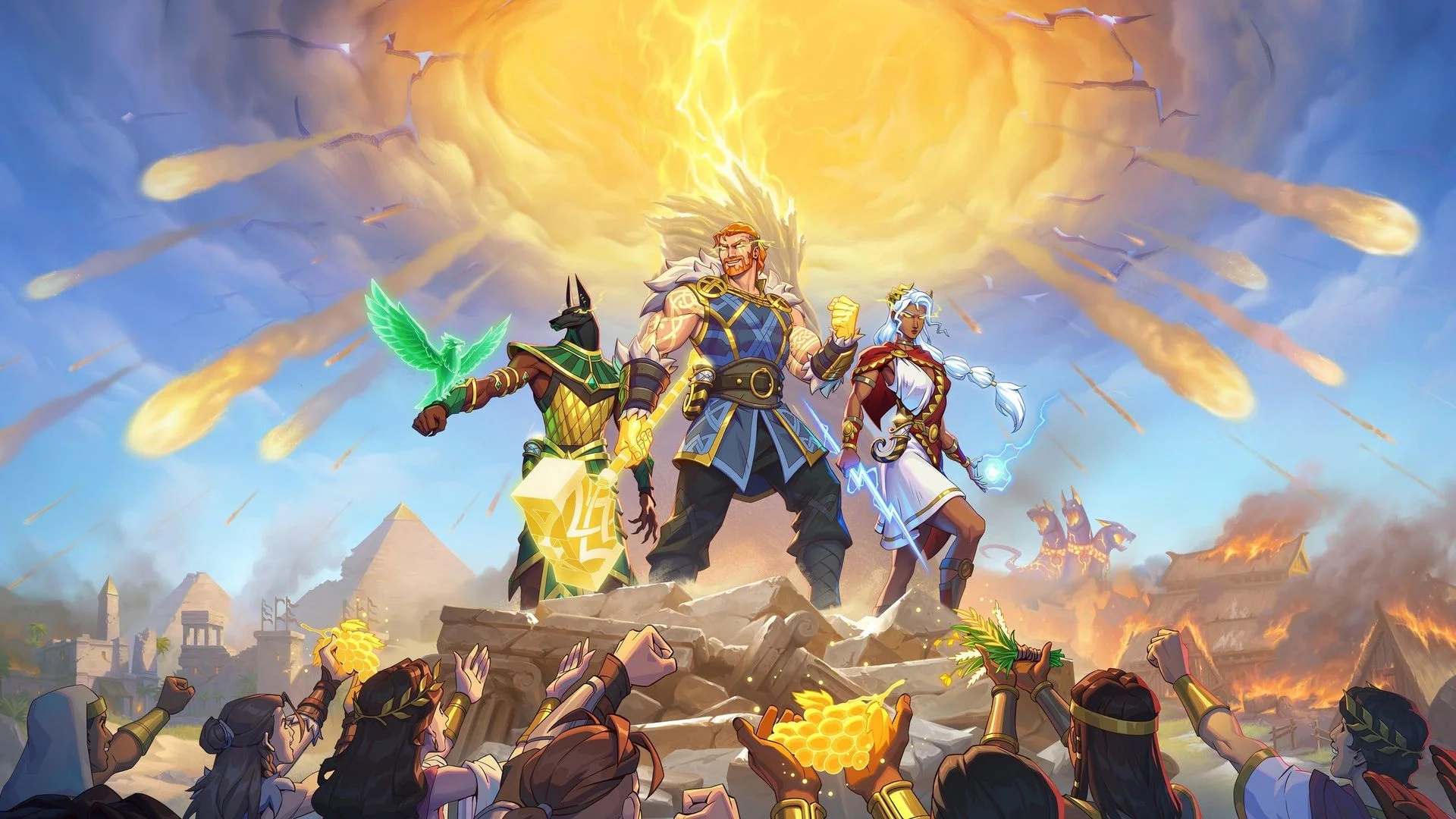
- Aftergods map: A handcrafted open world blending Greek, Egyptian, and Norse mythological realms after Ragnarok.
- Structure: Explore by region, not procedural tiles — each realm has distinct terrain and threats.
- Travel: Use Phoenix, Manticore, and Siren forms to cross air, land, and water routes.
- Key objective: Locate and recover World Tree seeds scattered across the realms.
- Preparation: Manage Nectar, food, and escape routes before entering dangerous zones.
Aftergods Map Overview: A Post-Ragnarok Open World
The Aftergods map is the stage for your entire journey as a Godborn. Following the destruction of Ragnarok and the shattering of the World Tree, the world is divided into regions shaped by different mythological traditions. Developed by Norsfell as a top-down open-world survival action RPG, Aftergods uses a handcrafted map rather than a procedurally generated one, meaning every realm, ruin, and hazard was placed with intention.
A handcrafted map rewards route planning and memory. Resource clusters, boss arenas, and dangerous zones stay in consistent locations, so scouting once pays off across your entire playthrough — solo or in co-op.
The map connects three confirmed mythological traditions plus areas tied to the unknown bloodline. Each region carries its own visual identity, terrain challenges, and exploration pacing, and crossing between them often requires the right movement form.
| Map Element | Description | Exploration Impact |
|---|---|---|
| Greek-themed regions | Classical architecture, coastal and elevated terrain | Vertical traversal, aerial routes |
| Egyptian-themed regions | Desert and monument-style landscapes | Long overland journeys, heat and exposure |
| Norse-themed regions | Cold, rugged, mythic wilderness | Hostile wildlife, harsh survival pressure |
| Unknown bloodline areas | Unresolved mystery zones | Discovery-focused, higher uncertainty |
| World Tree seed sites | Scattered restoration objectives | Core long-term exploration goals |
Realm Breakdown: Greek, Egyptian, and Norse Zones
Each pantheon-themed area of the Aftergods map presents a different exploration profile. Use this comparison to decide where your current equipment and Nectar reserves can take you.
Greek Realms
- Classical divine identity
- Coastal and elevated terrain
- Rewards aerial scouting with Phoenix
- Suited to survey-style exploration
Egyptian Realms
- Monument and desert themes
- Extended land crossings favor Manticore
- Strong visual and cultural identity
- Demands food and supply planning
Norse Realms
- Rugged mythic wilderness
- Highest environmental hostility
- Combat readiness is essential
- Tied to Ragnarok lore sites
Dangerous areas across all realms scale with how far you push beyond your preparation level. Scout gradually, enter with a clear objective, and always maintain a reliable escape route back to your base.
| Realm | Best Movement Form | Primary Risk | Recommended Priority |
|---|---|---|---|
| Greek | Phoenix (aerial) | Vertical exposure, falls | ★★★★ Early–Mid |
| Egyptian | Manticore (overland) | Supply depletion on long routes | ★★★ Mid |
| Norse | Manticore / mixed | Hostile encounters, cold zones | ★★★★ Mid–Late |
| Unknown areas | Form switching | Unpredictable threats | ★★ Late |
Cross-Region Travel: Shapeshifting Routes
The Aftergods map is designed around form-based traversal. Shapeshifting is not just a combat gimmick — it is the primary way you convert terrain barriers into routes.
Survey the Route
Before leaving your base, identify whether the journey ahead is dominated by air, land, or water obstacles. Mixed routes require planning multiple form transitions in advance.
Match Your Form to the Terrain
Choose Phoenix for elevated or open-air routes, Manticore for sustained ground travel and rough terrain, and Siren when water is the main path forward.
Stage Your Supplies
Place food, Nectar reserves, and spare equipment along the route or carry only what the expedition needs. Keep an emergency buffer untouched until the return trip.
Mark Objectives and Exits
Note World Tree seed locations, resource clusters, and at least one escape route per region. A marked exit converts a dangerous situation into a manageable retreat.
Return and Restock
End every expedition at your temple or base. Recover, repair gear, reassess Nectar, and only then plan the next leg deeper into the map.
Switch forms according to the obstacle ahead instead of committing to a single route through mixed environments. Flexible form use is the difference between a smooth crossing and a stranded expedition.
Danger Zones and Survival Prep on the Map
Survival pressure on the Aftergods map comes from hostile regions, giant monsters, and the tension between your divine and mortal forms. Nectar is the strategic resource that keeps your divine capabilities available — treat it as currency, not fuel to burn.
| Survival Factor | Priority | Recommended Action | Main Risk |
|---|---|---|---|
| Nectar reserves | High | Track supply before travel and combat | Arriving underprepared |
| Divine form | High | Deploy for difficult encounters and key expeditions | Treating power as unlimited |
| Mortal form | High | Avoid fights, retreat, rely on gear and positioning | Fighting past your limits |
| Food and sustenance | Medium | Prepare for the round trip, not just the outbound leg | Extending trips while depleted |
| Combat recovery | High | Recover at a safe location between engagements | Chaining fights while weakened |
Groups can divide map work: one player scouts routes, others manage gathering, combat pressure, and base support. Coordinate form changes when the party must cross air, land, or water together.
Expedition Checklist and Goals
Use this checklist before committing to any deep push across the Aftergods map.
Before Your Next Map Expedition:
- Confirm movement forms match the target region's terrain
- Verify Nectar reserves cover the full round trip
- Prepare food and spare equipment for recovery
- Mark one clear escape route per region entered
- Identify the expedition's primary objective (seed, resource, or boss)
Aftergods Map FAQ
Q: Is the Aftergods map procedurally generated?
No. Aftergods uses a handcrafted open-world map. Regions themed around Greek, Egyptian, and Norse mythology are placed intentionally, so resource locations and danger zones remain consistent between playthroughs.
Q: How do I travel between realms on the Aftergods map?
Cross-region travel relies on shapeshifting forms. Use Phoenix for aerial routes, Manticore for overland crossings, and Siren for water-based paths. In mixed regions, plan form transitions before you leave your base.
Q: What are the main exploration objectives on the map?
The central long-term objective is locating and restoring World Tree seeds scattered across the world. Along the way, you will map resource clusters, recruit survivors, and uncover regions tied to the unknown bloodline.
Q: Can I explore the whole map in co-op?
Yes. Aftergods supports solo play, online co-op, and offline play. Groups can split responsibilities — scouting, combat pressure, gathering, and base support — to cover more of the map safely.