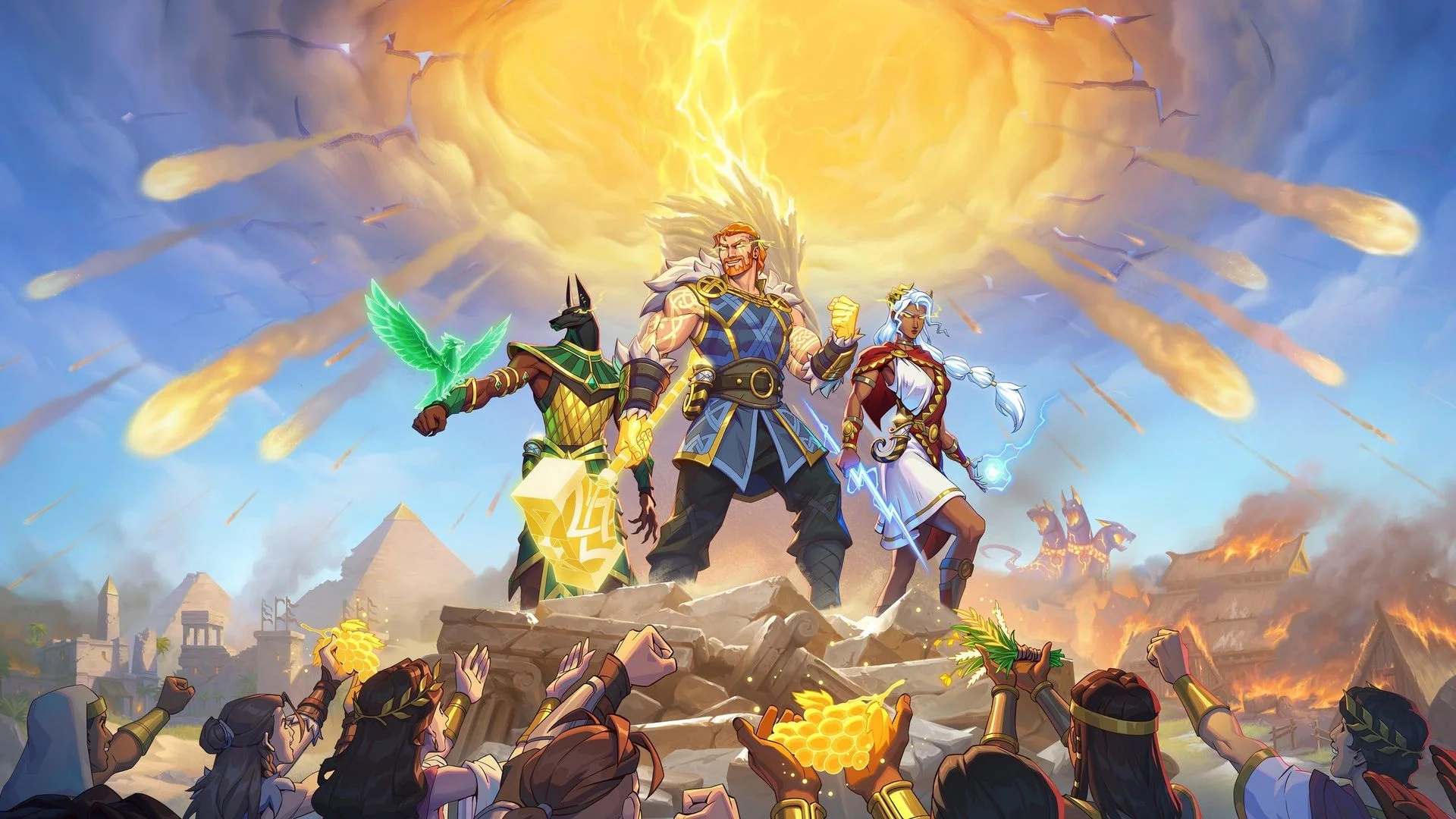
- Aftergods plot centers on a Godborn survivor rebuilding a shattered world after Ragnarok.
- World Tree seeds drive the main story: finding and restoring them heals the broken realms.
- Greek, Egyptian, and Norse mythologies collide in one post-divine open world.
- Divine vs. mortal forms create the core story tension through the Nectar resource.
- Recruiting followers and old gods builds a new pantheon and advances the narrative.
Aftergods Plot Overview: A World After the Gods
The Aftergods plot takes place in the aftermath of Ragnarok, the cataclysmic twilight of the gods. The old divine order has collapsed, the World Tree has been shattered, and its scattered seeds now lie buried across ruined realms. You play as a Godborn — a survivor carrying divine blood in a world where divinity itself is fading. Rather than simply enduring, your mission is to gather World Tree seeds, restore the broken world, and forge an entirely new pantheon from the wreckage of the old ones.
Developed by Norsfell and revealed on October 8, 2026, Aftergods blends its mythological storytelling with top-down open-world survival action RPG systems. The plot is not delivered through cutscenes alone — the story expresses itself through exploration, temple construction, follower recruitment, and battles against giant monsters. According to the official Steam page, the narrative supports solo play, online co-op, and offline experiences, so the story can be experienced alone or with friends.
The plot is the engine behind every gameplay system. World Tree seeds justify exploration, followers justify settlement building, and fading divinity explains the Nectar resource loop. Understanding the story makes every mechanic feel purposeful.
The Setting: Realms Born from Norse, Greek, and Egyptian Mythology
Aftergods does not restrict itself to one mythology. The shattered world mixes Norse, Greek, and Egyptian traditions into distinct regions, each carrying its own visual identity, terrain, and environmental threats. The broken World Tree acts as the connective tissue between these realms, and its seeds serve as the player's long-term exploration goals across the map.
| Realm Theme | Visual Identity | Terrain Focus | Story Role |
|---|---|---|---|
| Norse Regions | Ashen ruins, frost, runestone remnants | Cold wilderness, crags | Ground zero of Ragnarok lore |
| Greek Regions | Classical columns, olive landscapes, ruined temples | Coastal and hilly terrain | Echoes of a fallen Olympian order |
| Egyptian Regions | Sand-swept monuments, tombs, sun motifs | Desert and river crossings | Old gods waiting to be rediscovered |
| Unknown Areas | Undefined, mysterious | Mixed and dangerous | Tied to the unclassified bloodline mystery |
Because the world was hand-crafted rather than procedurally generated, each realm carries deliberate narrative weight — ruins and monuments tell the story of which pantheon fell, and where.
Beyond Greek, Egyptian, and Norse, an unresolved fourth bloodline category exists. Treat it as a story mystery rather than a confirmed faction — official details are still emerging as of October 2026.
The Godborn: Your Role in the Story
The protagonist's identity as a Godborn is the emotional core of the Aftergods plot. You exist between two states — a divine form empowered by mythic power, and a mortal form that is vulnerable but persistent. The resource Nectar mediates this tension: it sustains your divine power, and running low forces you back toward mortal limitations.
| Story State | Narrative Meaning | Gameplay Consequence |
|---|---|---|
| Divine Form | The Godborn channels inherited godhood | Stronger capabilities in combat and exploration |
| Mortal Form | Divinity fades; survival becomes human | Careful positioning, preparation, and retreat |
| Nectar | The lifeblood of fading divinity | Strategic resource management, not automatic spending |
This is why the plot matters mechanically. The story of "gods are gone, and you carry what remains" is expressed every time you decide whether to spend Nectar or fall back on mortal preparation.
Combat-Oriented Godborn
- Frames the plot as war against the giant monsters
- Prioritizes equipment readiness
- Best for hostile-region storytelling
Exploration-Oriented Godborn
- Frames the plot as a pilgrimage for World Tree seeds
- Focuses on routes, mapping, mobility
- Uses shapeshifting for travel
Builder-Oriented Godborn
- Frames the plot as rebirth through temple construction
- Develops settlement and production
- Anchors the new pantheon
Building the New Pantheon: Followers and Old Gods
A central plot thread is reconstruction. The old pantheons may have fallen, but survivors, ancient deities, and other followers remain scattered across the realms. Rescuing and recruiting them lets you assemble a new pantheon — a story beat that doubles as the game's recruitment and settlement system.
| Follower Type | Story Function | Settlement Role |
|---|---|---|
| Survivors | The mortal remnant who believe in you | Workforce and community growth |
| Old Gods | Living fragments of fallen pantheons | Faith progression, specialization |
| Automation Specialists | Rebuilders of a working world | Production and base efficiency |
| Expedition Supporters | Companions of your journey | Field support for exploration |
Encounter Survivors in the Realms
Explore ruined regions to find mortals and beings left behind after Ragnarok. Each rescue adds a potential follower to your growing community.
Recruit Old Gods
Track down ancient deities who survived the collapse. Their presence connects your settlement to the faith systems and deepens the lore.
Establish Your Temple
Construct a temple as the physical heart of your new pantheon. Begin with functional structures, then expand into monuments worthy of a new divine order.
Grow Faith and Influence
Develop follower assignments, automation, and faith to transform a scattered remnant into a pantheon that can challenge the giant monsters threatening the world.
Assign followers according to your settlement's current bottleneck rather than spreading them across every task. The story of rebuilding works best when your pantheon grows deliberately.
Plot-Driven Gameplay: Shapeshifting, Seeds, and Giant Monsters
The remaining story beats flow through three systems: shapeshifting into mythical creatures, hunting World Tree seeds, and confronting giant monsters. Shapeshifting into forms like the Phoenix, Manticore, and Siren reflects the Godborn's inherited divine power — you literally wear the myths of the fallen world.
| Mythical Form | Movement Role | Plot Significance |
|---|---|---|
| Phoenix | Aerial exploration | Flight and rebirth imagery tied to divine renewal |
| Manticore | Land traversal | Overland expeditions through hostile wilderness |
| Siren | Aquatic exploration | Crossing water-separated regions of the shattered world |
The World Tree seeds function as the plot's central MacGuffin and its long-term progression goal. Each seed restored pushes the world — and the story — closer to recovery. Giant monsters stand in your way as the remnants of the old world's collapse, and they can be challenged solo or through online co-op with P2P hosting and dedicated server support, per Gematsu's coverage.
Groups can divide gathering, combat, and construction roles, letting each player express a different facet of the plot — warrior, explorer, or builder — within a shared expedition.
Story Progression Checklist and FAQ
Track your narrative progress through the core plot milestones:
Aftergods Plot Milestones:
- Learn the Godborn divine and mortal form system
- Establish a safe base and begin your temple
- Rescue your first followers and survivors
- Recruit an old god into your pantheon
- Master Phoenix, Manticore, and Siren forms
- Recover your first World Tree seed
- Defeat a giant monster in solo or co-op play
Q: What is the Aftergods plot about?
The Aftergods plot follows a Godborn survivor in a world destroyed by Ragnarok. Your goal is to gather scattered World Tree seeds, recruit survivors and old gods into a new pantheon, and restore a shattered realm blending Norse, Greek, and Egyptian mythology.
Q: Who do you play as in Aftergods?
You play as a Godborn — a character with divine blood tied to Greek, Egyptian, Norse, or an unknown bloodline. You shift between a divine form powered by Nectar and a vulnerable mortal form, which is the story's central tension.
Q: How does the plot connect to gameplay?
Every system serves the story: World Tree seeds drive exploration, temple building represents rebuilding civilization, follower recruitment forms your new pantheon, and shapeshifting into creatures like the Phoenix expresses your inherited divinity.
Q: Can I experience the Aftergods story in co-op?
Yes. Aftergods supports solo play, online co-op, and offline play with P2P hosting and dedicated servers. Giant monster encounters and World Tree seed expeditions can be tackled together with divided team roles.